 SEA5
SEA5 WSH3
WSH3 VAN2
VAN2 NYR6
NYR6 CAR4
CAR4 PHI1
PHI1 FLA
FLA BUF
BUF OTT
OTT NJD
NJD VGK
VGK MIN
MIN DET
DET CBJ
CBJ MTL
MTL TBL
TBL STL
STL NYI
NYI PIT
PIT CHI
CHI WPG
WPG COL
COL DAL
DAL NSH
NSH TOR
TOR UTA
UTA CGY
CGY ANA
ANA EDM
EDM LAK
LAK BOS
BOS SJS
SJS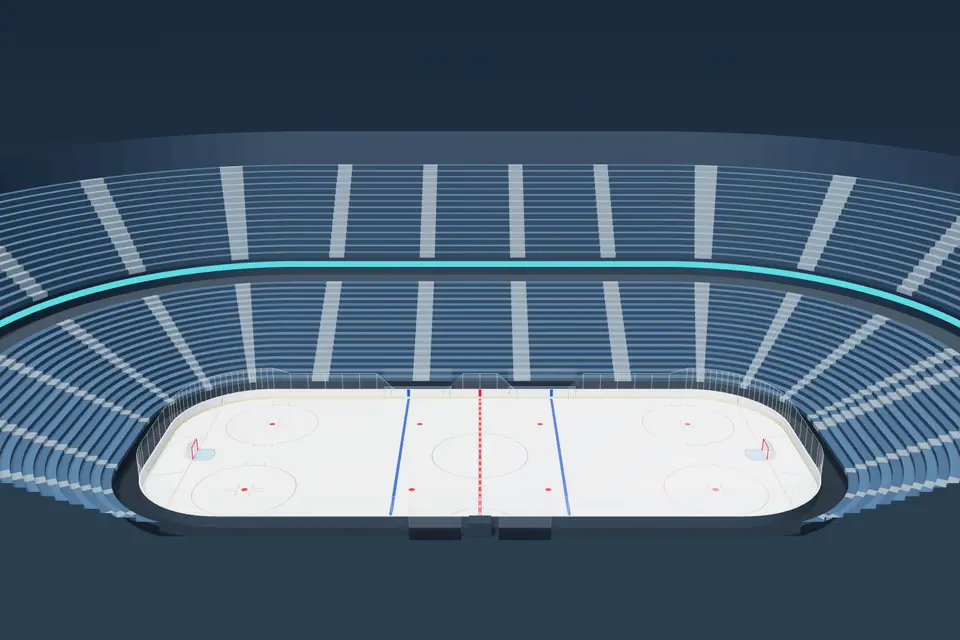
The arena around the ice
From the broadcast camera the rink looks simple: a white sheet, a wall of boards and a ring of glass. The boards stand 42 inches above the ice, the ideal height in the rulebook, which allows anything from 40 to 48 inches. Above them, safety glass rises 8 feet at each end and at least 6 feet along the sides, so the top of the end glass sits about 11.5 feet above the ice. Even the color is set by rule: the surface and the boards are white, and only the kick plate at the bottom of the boards is light yellow.
NHL rink dimensions
The official sheet is 200 feet long and 85 feet wide, with corners rounded in an arc of a 28-foot radius. Those corners matter more than they look. Cutting a quarter-circle out of each corner removes 673 square feet, so the ice you actually skate on is about 16,327 square feet, and the boards that wrap it run about 522 feet.
The goal lines sit 11 feet from each end. The blue lines are drawn 64 feet out from the goal lines, which leaves a 50-foot neutral zone in the middle and 75 feet from each blue line to the end boards. The end-zone faceoff dots sit 20 feet out from the goal line and 22 feet either side of center, inside circles with a 15-foot radius. If you use the Shot Lab, these are the same lines its zones are built on.
International hockey plays on a bigger sheet. The IIHF rule book sets its rink at 60 meters long and 26 to 30 meters wide, with corners of 7 to 8.5 meters. At the widest setting that is about 196.9 by 98.4 feet, roughly 2,380 square feet more ice than an NHL rink, almost all of it in width. The compare button in the 3D view lays that outline over the NHL sheet.
What sits under the ice
Strip the ice away and you find a concrete floor laced with pipes. Those pipes carry a chilled glycol or brine solution, and that cold fluid is what freezes the water crews spray on top. When the league builds a new sheet, the refrigeration is first set to 16-18°F, about -8.9 to -7.8°C. The NHL also tracks the temperature in the panels themselves: its Eye on the Ice cables read the floor and the ice an inch above it, and crews check the surface with an infrared gun.
How NHL ice is made, layer by layer
NHL ice is not poured in one go. Crews start with 5 to 6 light sprays of cold water to bond a first thin film to the floor. Then come 3 coats of water-soluble white paint, which is why the sheet looks white rather than gray. The lines and rink markings are painted next, and the logos go into the same layer. Another 5 to 6 light sprays seal all of it in.
Only then does the sheet get its body: about 100 gallons at a time over a few days, 10,000 to 15,000 gallons in all, until the ice is 1 to 1.5 inches thick. Our own arithmetic agrees with that range: covering 16,327 square feet one inch deep takes about 10,178 gallons, and an inch and a half takes about 15,267. Jet Ice, which supplies ice paint, recommends building floods with water at 140-160°F.
NHL ice temperature, and the air above it
The top of the playing surface is held at a steady 22 to 23°F, roughly -5.6 to -5.0°C. The building itself is kept at 60 to 64°F with 40 to 45% humidity during games. That leaves the air 37 to 42 degrees warmer than the ice a few inches below the players' skates, a gap the refrigeration fights all night. The Ontario Recreation Facilities Association gives 22-24°F as the range for hockey ice, slightly colder than the 24-26°F it lists for public skating.
Resurfacing between periods
The rulebook says the ice is flooded between periods. A resurfacer washes the sheet, shaves the top off and leaves a thin layer of ice-making water behind it, spread by a towel at the back of the machine. In the NHL that is about 100 gallons per resurface. Spread over the whole sheet, our model makes that a film only about 0.010 inches thick, which is why it can freeze in 5 to 6 minutes inside an intermission of no more than 14 minutes.
Crews also work during the game. At each commercial time-out they shovel snow from the creases, the bench areas and the end zones. In the regular season the whole sheet is shoveled again before overtime and before a shootout, the same way. If you follow how those extra periods settle bets, our overtime and shootout rules page covers it.
When the ice goes wrong
Ice has a narrow comfort zone, and the "break it" step lets you push it out of that zone. The facilities association notes that warmer ice lets a skate blade cut deeper, while very dry air below 40% humidity makes the surface sublimate into a rough, granular finish. Humidity works the other way too: when the air's dew point is above the ice temperature, moisture condenses on the sheet as frost. At 60-64°F and 40-45% humidity the dew point already works out to 36-42°F, so every extra point of humidity adds to the work. The league's own crew counts at least 30 different things that can affect ice quality.
Checking the numbers
Jet Ice says an NHL-sized rink takes about 10,600 gallons of water if the floor is level. Our geometry turns that into 1.04 inches of ice across the whole sheet, right in line with the "about 1 inch" the AP reported for indoor NHL ice and inside the ¾ to 1½ inch range Jet Ice gives. In other words, the ice under a game is about as thick as the puck, which the rules set at 1 inch thick and 3 inches across. The home team keeps those pucks frozen.
What it means on game night
None of this changes how a bet is graded, and we do not claim the ice decides games. It does explain what you see on a broadcast: the crews shoveling at TV time-outs and before overtime, and the resurfacers circling at intermission. For the numbers that do go into a price, start with the starting goalies board, read how the puck line works, or go back to the hockey betting home page for tonight's games.
Sources
Every measurement on this page comes from the documents below. The 3D view and the panel compute the rest themselves: area, volume, gallons, Celsius and dew point.
- NHL Official Rules 2024-25, Rules 1, 2 and 13
- IIHF Official Rule Book 2024/25, Rule 1
- Popular Mechanics: how the NHL makes and maintains its ice (Mike Craig, NHL facility operations), 2022
- Jet Ice, ice making FAQ
- ORFA, Understanding Artificial Ice Operating Temperatures
- Zamboni: how an ice resurfacer works
- Zamboni fun facts
- AP via ESPN: how the NHL keeps outdoor ice playable, 2019
- NHL.com: Eye on the Ice, the league's ice temperature monitoring